
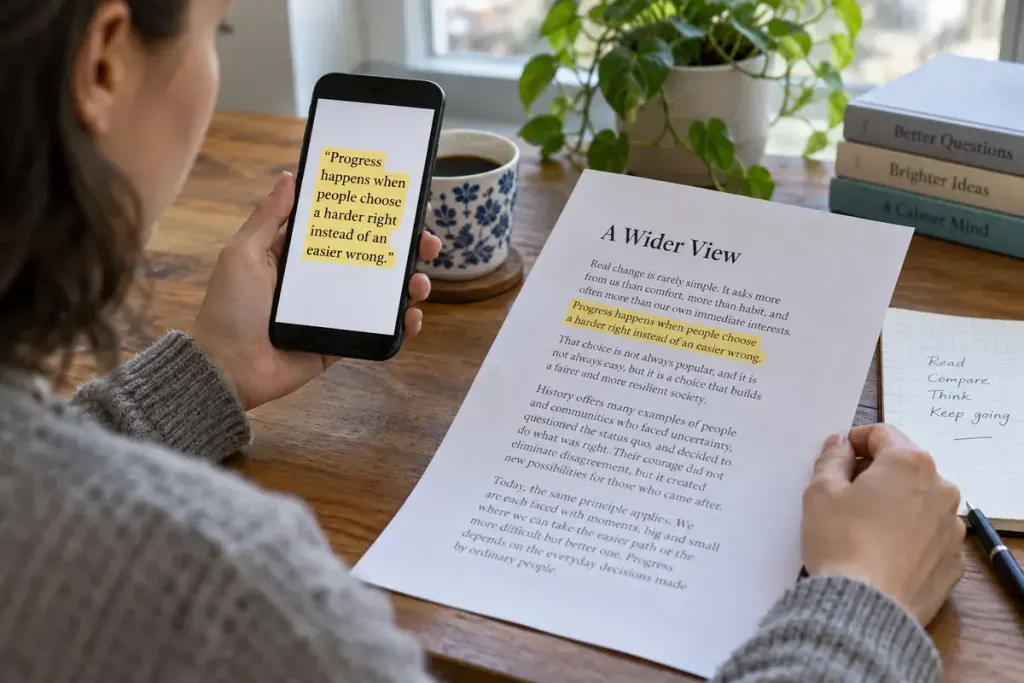
A quotation in a headline can be accurate word for word and still leave you with the wrong impression. The missing material may explain who the speaker meant, the conditions they attached or whether they were describing someone else’s view.
Start by finding the original interview, speech, transcript or document where possible. A second article repeating the same short quote is not an independent check of its context.
Read before and after the extract
Look for the question that prompted the answer. Then read enough of the response to understand any qualification. Words such as if, unless, some and currently can carry much of the meaning even when they are not the most memorable part of the sentence.
Consider this invented example: “We support the proposal if the access problems are resolved.” A shortened version that says only “We support the proposal” removes the condition. The remaining words were spoken, but the practical position has changed.
An ellipsis signals an omission, not permission to assume that the missing material was unimportant. Square brackets may clarify a reference, but check whether the clarification is justified by the original. Neither mark guarantees a fair edit on its own.
Keep uncertainty visible
If you cannot find the full source, say that you have only the reported extract. Distinguish a direct recording from a transcript, a translation or a journalist’s notes. Each can be useful, but they are different forms of evidence.
When sharing the quote, include the source link and enough surrounding explanation to preserve the point. Avoid adding a confident interpretation that the source does not support.
This check need not become a search for hidden dishonesty in every shortened sentence. Editing is often necessary. The question is whether the extract still represents the statement fairly, including the limits that made it meaningful.