
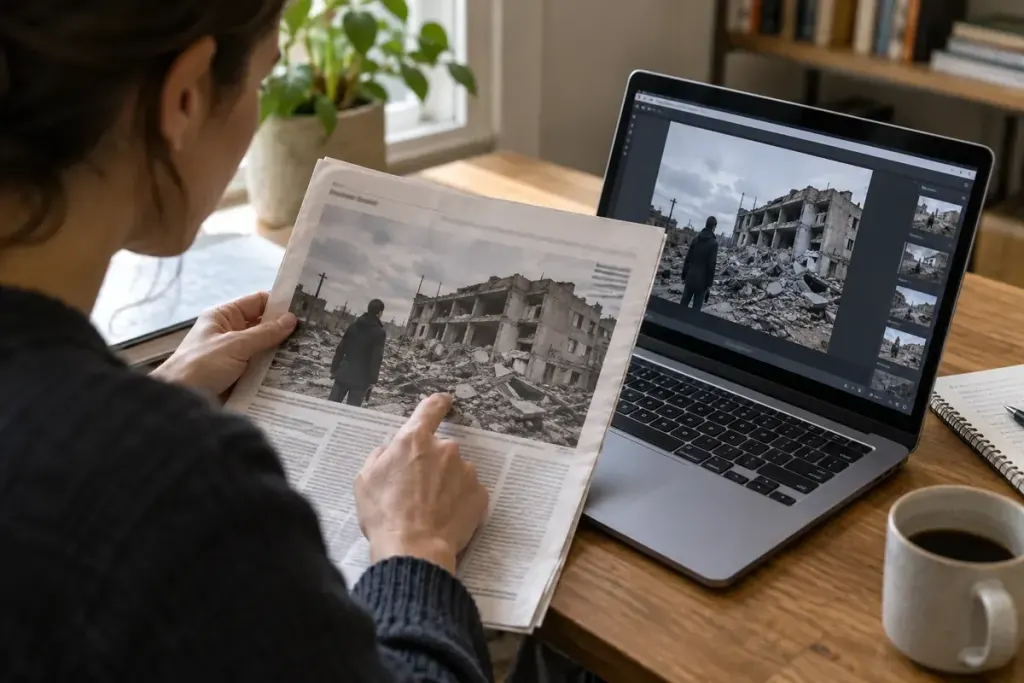
A photograph can be real while the sentence above it is wrong. An old crowd image can be attached to a new protest; a weather photograph can be labelled as a different city. Looking for obvious editing alone will miss that kind of mismatch.
Write down the claim you are checking
Separate the visible image from the caption’s assertions. “People are standing in water” is an observation. “This happened this morning outside a named station” adds a time and place that the picture may not establish.
Check the original post or article rather than only the screenshot. Look for a photographer credit, agency name, publication date and explanatory caption. A screenshot can crop out all four. If the image came from a gallery, check that the caption belongs to that particular frame.
Look for an earlier context
A reverse-image search can help locate other appearances, but its results are leads rather than proof. Open the pages and compare the actual image, not just similar subjects. Search for distinctive details such as a visible sign or building, while recognising that signs can be cropped, translated or misread.
Imagine finding the same photograph in a newspaper archive dated two years before the event claimed in a new post. That is strong evidence against the new date. It does not, by itself, verify every detail of the older caption. Follow the credit toward the original publisher or photographer where possible.
- Distinguish the upload date from the capture date.
- Notice whether the image is labelled file photo or illustration.
- Check whether a crop removes relevant surroundings.
- Keep uncertainty visible when the original cannot be found.
When sharing a correction, link to the evidence and describe the specific mismatch. Avoid inventing a more confident story to replace the first one. Sometimes the accurate conclusion is limited: the image is older than the claim, while its exact original location remains unverified.