You know what their apartment looks like.
You recognize the sound of their laugh. You know which games they play when they are tired, what they usually order for dinner, how they react when something goes wrong, and which stories they have told a dozen times.
They may have appeared on your screen hundreds of times.
But they have never met you.
This strange sense of familiarity has become a normal part of modern entertainment. Streamers, YouTubers, podcasters, influencers, and other online personalities can occupy a very different place in our lives from traditional celebrities.
Understanding why we feel connected to online creators means looking beyond simple fandom. The format of online entertainment creates repeated exposure, perceived intimacy, routines, community participation, and forms of interaction that can make a distant public figure feel surprisingly familiar.
Online Entertainment Changed the Distance Between Audience and Performer
Traditional entertainment usually creates a clear separation.
An actor appears in a film.
A musician performs on stage.
A television presenter hosts a program.
The audience sees the performance, but relatively little of the ordinary life surrounding it.
Online creators often operate differently.
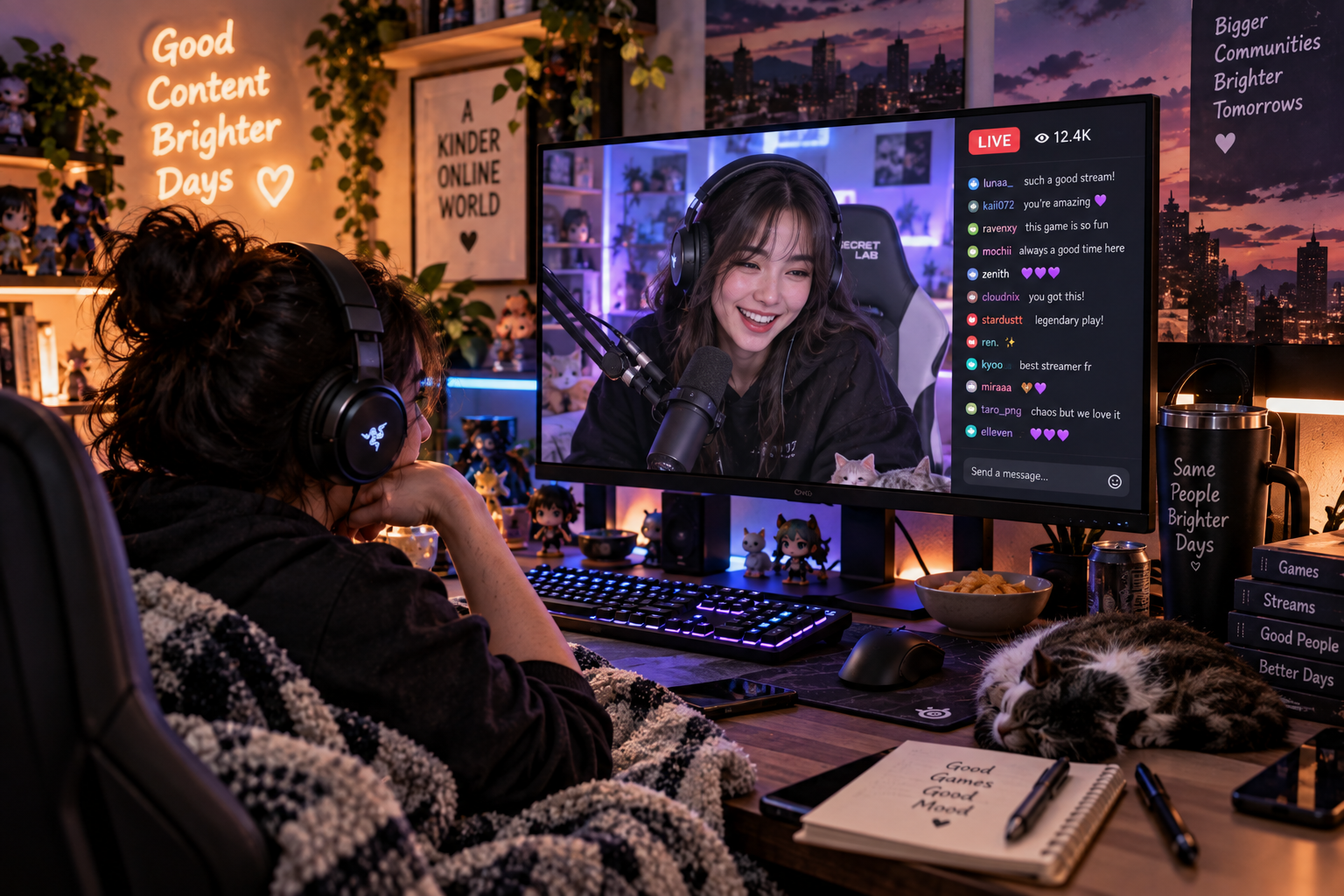
A streamer might broadcast from a bedroom for five hours. A podcaster talks casually every week. A video creator shares mistakes, routines, personal stories, behind-the-scenes moments, and unfinished thoughts.
The audience is no longer seeing only polished performances.
They are repeatedly exposed to something that resembles everyday interaction.
Familiarity Builds Through Repetition
Imagine listening to the same podcast every morning during your commute.
One episode becomes twenty.
Twenty becomes one hundred.
Eventually, the hosts’ voices become part of a familiar routine.
You begin predicting their jokes or knowing how one person will react when another raises a particular topic.
This does not require direct communication.
Repeated exposure alone can create familiarity.
The same mechanism helps explain why characters in long-running television series can feel familiar, but online creators add another layer: they often appear to be speaking as themselves rather than playing fictional roles.
The Camera Creates an Unusual Kind of Eye Contact
Many creators speak directly into a camera.
Visually, that can resemble a conversation.
They look toward the viewer.
They ask rhetorical questions.
They tell stories using conversational language.
They may even say things such as “you guys know what I mean” or respond to comments from previous content.
Of course, a recorded video cannot actually see the individual viewer.
But the presentation style borrows cues from face-to-face communication.
That can make watching feel less like observing a distant performance and more like being addressed personally.
Long-Form Content Creates More Room for Personality
A two-minute interview gives an audience limited information about someone’s personality.
A four-hour livestream is different.
Long-form formats contain pauses, mistakes, unexpected reactions, tangents, boredom, frustration, and ordinary conversation.
These moments can feel revealing precisely because they are less polished.
Audiences begin learning behavioral patterns.
Not because they have access to the creator’s complete private personality, but because they have accumulated many hours of observations.
The amount of exposure can make the relationship feel deeper than the actual level of mutual knowledge.
Livestreaming Makes the Relationship Feel More Immediate
Recorded entertainment moves in one direction.
The creator produces something, and the audience watches later.
Livestreaming introduces simultaneity.
Creator and audience are present at approximately the same moment.
Chat reacts.
The creator reads a message.
Someone makes a joke and receives a response.
A viewer suggests something that changes what happens next.
Even when thousands of people are watching, these moments can make the audience feel less passive.
They are not merely consuming a finished product.
They are present while the entertainment is happening.
Recognition Makes the Connection Stronger
For regular viewers, one small interaction can have disproportionate emotional significance.
A streamer recognizes a username.
A creator replies to a comment.
A podcast reads a listener’s question.
Suddenly, a relationship that was previously one-sided contains a tiny moment of acknowledgment.
That does not transform the creator and viewer into friends.
But it changes the experience.
The viewer is no longer completely invisible.
This possibility of recognition is one reason creator communities can feel different from traditional celebrity fandom.
Parasocial Relationships Are Not Automatically Unhealthy
The term parasocial relationship is often used as though it describes something inherently negative.
Originally, the concept refers broadly to one-sided relationships audiences develop with media personalities.
The important characteristic is asymmetry.
You may know a great deal about the public figure.
They know little or nothing about you.
That imbalance does not automatically make the experience harmful.
People have formed attachments to performers, presenters, athletes, fictional characters, and public personalities for generations.
Online media has simply made the phenomenon more frequent, interactive, and intimate.
The Problem Begins When the Relationship Is Misunderstood
Feeling emotionally connected to a creator is one thing.
Assuming that connection is equivalent to a mutual private friendship is another.
A viewer may have watched hundreds of hours of someone’s life, but those hours still represent selected portions of that person’s existence.
The creator does not have equivalent knowledge about the viewer.
Maintaining that distinction matters.
A healthy media relationship can include affection, admiration, comfort, or community without pretending that the asymmetry does not exist.
“Authentic” Does Not Mean Completely Unfiltered
Online creators are frequently praised for authenticity.
They seem more natural than traditional celebrities.
They film at home.
They speak casually.
They leave mistakes in videos.
They discuss personal experiences.
But authenticity and complete access are not the same thing.
A creator can genuinely express their personality while still deciding what belongs on camera.
They choose when to start recording.
They choose what stories to tell.
Recorded content can be edited.
Livestreamers still decide which parts of their lives remain private.
The version viewers know may be sincere while still being incomplete.
Editing Can Make Personality Feel More Concentrated
Imagine spending an entire day with someone.
Much of it would be ordinary.
Silence.
Routine tasks.
Waiting.
Small conversations.
A twenty-minute video can compress hours of recording into only the most interesting moments.
The result is a concentrated version of personality.
More jokes.
More reactions.
More stories.
More emotional moments.
This can make creators seem consistently entertaining in a way that no person could realistically maintain every minute of ordinary life.
The audience is experiencing a curated density of personality.
Vulnerability Can Deepen Audience Attachment
Creators sometimes talk openly about failure, insecurity, relationships, career struggles, grief, burnout, or difficult periods in their lives.
These disclosures can create powerful moments.
Viewers may recognize their own experiences in what the creator describes.
That sense of identification can strengthen emotional connection.
But vulnerability online also exists within a public context.
Some disclosures are spontaneous.
Others are carefully considered.
Either way, viewers should remember that being invited into one personal story does not necessarily mean they have access to the creator’s entire private life.
Shared Routine Can Matter More Than the Content
Sometimes the attachment is not primarily about what the creator makes.
It is about when they appear.
A livestream happens every evening after work.
A podcast arrives every Monday morning.
A particular channel becomes something you watch while eating dinner.
Over time, the creator becomes attached to a routine.
When the content suddenly stops, the absence can feel surprisingly noticeable.
The viewer is not only missing entertainment.
A familiar part of their daily or weekly rhythm has disappeared.
Creators Can Become Background Companionship
Not all online content receives full attention.
People leave streams running while working.
They listen to podcasts while cleaning.
Long videos play while they cook.
A familiar voice occupies the room.
This creates a form of background companionship that traditional media can also provide, but creator-led formats are particularly suited to it because they often involve casual conversation.
The content does not always demand complete attention.
Its presence itself can become comforting.
Communities Strengthen the Experience
The connection may not only be between viewer and creator.
It can also be viewer to viewer.
Regular audiences develop shared jokes, references, vocabulary, traditions, memes, and expectations.
People recognize each other in chat.
Discord communities form.
Fans discuss episodes, streams, games, or creative projects elsewhere.
At that point, the creator becomes the center of a broader social environment.
Someone may initially arrive for the content and remain partly because they enjoy the community surrounding it.
Inside Jokes Create a Sense of Belonging
Watch a creator for the first time and some jokes make no sense.
Regular viewers understand immediately.
That difference creates a subtle boundary between newcomers and established members of the audience.
Knowing the references signals familiarity.
It says, in effect, “I’ve been here long enough to understand this.”
This is common across fandoms.
Sports supporters have chants.
Music fans recognize obscure references.
Television fandoms repeat memorable lines.
Creator communities simply generate these cultural markers much faster because content can appear daily.
Algorithms Can Intensify Familiarity
Watch one creator frequently and recommendation systems may show you more of them.
Clips.
Interviews.
Collaborations.
Short videos.
Fan edits.
Reaction content.
Suddenly, the creator appears across several platforms.
This repeated visibility can make them feel culturally omnipresent within your personal media environment.
It is worth remembering that this does not necessarily mean everyone else sees the same person constantly.
Personalized feeds can create highly individual entertainment worlds.
Collaborations Build a Social Universe
Online creators rarely exist completely alone.
They collaborate.
Appear on each other’s streams.
Join podcasts.
Play games together.
Attend events.
The audience gradually learns the relationships between multiple personalities.
This can create something resembling an ongoing ensemble show, except the boundaries between entertainment and real social relationships are less obvious.
Viewers may become invested not only in individual creators but also in the dynamics between them.
That makes the entertainment world feel larger and more continuous.
Audience Expectations Can Become Heavy
The same familiarity that helps creators build loyal communities can create pressure.
Viewers become accustomed to regular access.
If a creator changes schedule, stops discussing personal topics, begins making different content, or establishes stronger boundaries, some audience members may react negatively.
The unspoken expectation becomes:
“You used to share this with us.”
But access to someone’s content does not create ownership over their life.
Creators are allowed to change.
They can become more private.
They can stop making a format audiences loved.
The relationship may feel familiar, but the creator still controls what they choose to share.
Popularity Can Change the Relationship
A small creator may respond to nearly every comment.
As the audience grows, that becomes impossible.
The creator who once recognized most regular viewers now sees thousands of usernames.
Some early followers interpret this as the creator becoming distant.
Sometimes personality genuinely changes.
But scale itself changes what interaction is possible.
One person cannot maintain individual relationships with hundreds of thousands of viewers.
Growth can therefore transform the audience experience even when the creator’s intentions remain similar.
Fans Often Defend Creators Like Personal Friends
When a creator receives criticism, some viewers react with remarkable intensity.
They argue with strangers.
Search for evidence.
Attack critics.
Defend decisions they know little about.
Part of this can come from ordinary fandom loyalty.
But perceived familiarity may also make criticism feel personal.
If someone has been part of your daily routine for years, an attack on them can emotionally resemble an attack on someone you know.
The important distinction is remembering that audiences usually possess incomplete information about conflicts occurring in a creator’s private or professional life.
The Opposite Can Happen Too
Strong parasocial attachment does not always produce admiration.
It can produce resentment.
A viewer may become frustrated because the creator changes.
Stops responding.
Gets into a relationship.
Becomes more successful.
Moves away from the content that originally attracted the audience.
The emotional logic can resemble disappointment in a personal relationship even though the relationship was never mutually personal.
This helps explain why creator fandom can shift rapidly from intense affection to intense hostility.
Both reactions can grow from an exaggerated sense of personal investment.
Enjoy the Connection Without Pretending It Is Something Else
Online creators can genuinely matter to people.
Their work can provide entertainment during difficult periods.
Introduce someone to a hobby.
Create friendships between viewers.
Offer new ideas.
Make ordinary routines more enjoyable.
None of that needs to be dismissed simply because the relationship is parasocial.
The useful boundary is recognizing what kind of relationship it actually is.
You can appreciate someone you have never met.
You can feel familiar with their work and public personality.
You can participate in their community.
But familiarity created through media is not the same as mutual private intimacy.
Both ideas can be true at once.
Conclusion
Understanding why we feel connected to online creators requires looking at how modern entertainment has changed the relationship between audiences and public personalities.
Creators can appear in our homes every day, speak directly to the camera, share personal stories, interact with live chat, respond to comments, and become part of routines that continue for years. Long-form content gives audiences far more exposure to personality than many traditional entertainment formats ever could.
Communities, inside jokes, algorithms, livestreams, and occasional direct interactions strengthen that familiarity even further.
The resulting connection can be enjoyable and meaningful.
It becomes easier to understand when we remember one simple distinction: knowing a great deal about someone’s public life is not the same as that person knowing us.
You may recognize their laugh before they even finish the joke.
You may know exactly what they are going to say next.
You may have watched them for hundreds of hours.
That familiarity is real.
But it was created through a screen—and understanding that boundary is part of understanding modern entertainment itself.